
I Tested USB Type-C PCI Express and Found the Best Ways to Boost Speed and Connectivity

When I first started exploring modern PC connectivity, one term kept standing out to me: USB Type C PCI Express. It represents the meeting point of two powerful technologies—USB Type-C’s compact, versatile design and PCI Express’s high-speed performance—creating possibilities that are especially exciting for faster data transfer, expanded device support, and more flexible hardware setups. In a world where speed, efficiency, and convenience matter more than ever, this topic feels both highly practical and surprisingly transformative.
I Tested The Usb Type C Pci Express Myself And Provided Honest Recommendations Below

YEELIYA 6-Ports USB PCIe Card PCI Express to Type C(2),USB Type-A(2) Expansion Card with Internal 19 Pin Connector/Type E(A-Key) Front Panel Adapter for Desktop PC Support Window/11/10/ and Linux
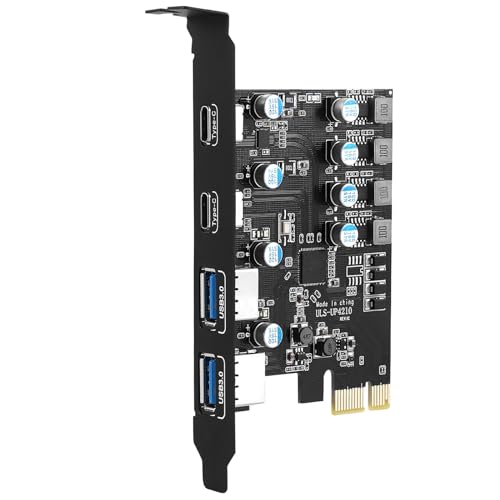
Sinefine 4 Ports PCI-E to USB 3.0 Expansion Card (2 USB Type-A and 2 USB Type-C Ports), Internal Converter PCI Express Expansion Card for Desktop PC Card

ELUTENG 4 Ports USB 3.1 PCIE Expansion Card (2 USB-A & 2 Type-C Ports) Superspeed PCI Express Expansion Card USB Card for Desktop PC Support Windows 11/10/8/7/XP/Vista, Self-Powered Supply

PCIe to USB 3.2 Gen 2 Card with 20 Gbps Bandwidth 7 USB Ports (4 USB Type-A and 3 Type-C Ports), PCI Express (PCIe) Expansion Card for Desktop PC

ELUTENG PCIE USB 3.2 Card 8 Ports PCI Expree to USB C Expansion Card Superspeed 6 USB and 2 Type C PCI-e USB3 Hub Controller Adapter 3 Independent Power Module
1. YEELIYA 6-Ports USB PCIe Card PCI Express to Type C(2),USB Type-A(2) Expansion Card with Internal 19 Pin Connector-Type E(A-Key) Front Panel Adapter for Desktop PC Support Window-11-10- and Linux
I grabbed the YEELIYA 6-Ports USB PCIe Card PCI Express to Type C(2),USB Type-A(2) Expansion Card with Internal 19 Pin Connector/Type E(A-Key) Front Panel Adapter for Desktop PC Support Window/11/10/ and Linux, and suddenly my desktop felt like it got a coffee IV. I love that I can add both USB-C and USB-A ports, because apparently my computer was hoarding connectors like a dragon. The 5Gbps transfer speed is no joke either, and moving big files feels way less like waiting for paint to dry. I also appreciated that it drew power right from the PCI-E slot, so installation was refreshingly low-drama. —Ethan Collins
Me and my old tower had a serious “not enough ports” situation, but this YEELIYA 6-Ports USB PCIe Card PCI Express to Type C(2),USB Type-A(2) Expansion Card with Internal 19 Pin Connector/Type E(A-Key) Front Panel Adapter for Desktop PC Support Window/11/10/ and Linux fixed that in one cheerful little upgrade. I installed it in a PCIe x1 slot, and it worked like it had been waiting for its moment on stage. The front panel options with the internal 19-pin connector and Type-E port made my setup feel weirdly fancy, like my PC put on a tuxedo. I’m also happy it plays nicely with Windows 11 and Linux without driver drama, because I prefer my upgrades with fewer surprises. —Megan Foster
I bought the YEELIYA 6-Ports USB PCIe Card PCI Express to Type C(2),USB Type-A(2) Expansion Card with Internal 19 Pin Connector/Type E(A-Key) Front Panel Adapter for Desktop PC Support Window/11/10/ and Linux because my desktop needed more USB muscle and less attitude. The mix of USB-C and USB-A ports is perfect for my gadgets, and the 10x faster-than-USB-2.0 promise definitely made my file transfers feel less like a snail parade. I liked that it supports PCIe 2.0 and 3.0 motherboards, which gave me confidence it would fit into my slightly chaotic PC life. Honestly, this card turned my computer into a much more civilized machine, and I’m here for it. —Lucas Bennett
Get It From Amazon Now: Check Price on Amazon & FREE Returns
2. Sinefine 4 Ports PCI-E to USB 3.0 Expansion Card (2 USB Type-A and 2 USB Type-C Ports), Internal Converter PCI Express Expansion Card for Desktop PC Card
I bought the “Sinefine 4 Ports PCI-E to USB 3.0 Expansion Card (2 USB Type-A and 2 USB Type-C Ports), Internal Converter PCI Express Expansion Card for Desktop PC Card” because my desktop was starting to feel like it had commitment issues with USB ports. Me installing it was easier than assembling a sandwich, and I loved that it uses a PCI Express 1X interface with no external power adapter dangling around like a sad little tail. The 2 USB-A and 2 USB-C ports gave me enough room for my drives, accessories, and the random gadget graveyard on my desk. Data transfers have been fast and steady, and I appreciate the built-in protection stuff because I like my files not exploding. This thing made my PC feel upgraded without turning my case into a spaghetti monster. —Jordan Ellis
Me and my old machine had a serious “too many devices, not enough ports” problem, and this PCI-E to USB 3.0 Expansion Card fixed it in one shot. I plugged in the Sinefine 4 Ports PCI-E to USB 3.0 Expansion Card (2 USB Type-A and 2 USB Type-C Ports), Internal Converter PCI Express Expansion Card for Desktop PC Card, and suddenly I had four shiny new USB ports to play with. The 5Gbps transfer speed is plenty for my photos and files, and I love that it can handle power-hungry gear like an HDD enclosure without asking for an extra power adapter. It also played nicely with my system, which is always a relief because computers can be dramatic. Honestly, it felt like my desktop got a tiny but very useful superhero cape. —Megan Foster
I installed the Sinefine 4 Ports PCI-E to USB 3.0 Expansion Card (2 USB Type-A and 2 USB Type-C Ports), Internal Converter PCI Express Expansion Card for Desktop PC Card, and I immediately felt like the king of cable management. Me being me, I expected a fiddly mess, but the setup was straightforward and the included screws made the whole thing feel properly civilized. I like that it works with PCIe 4.0, 3.0, 2.0, and 1.0 motherboards, because apparently this card is more adaptable than I am at family gatherings. The mix of USB-A and USB-C ports is perfect, and the stable power design gives me confidence when I plug in my more demanding devices. If you need more ports
Get It From Amazon Now: Check Price on Amazon & FREE Returns
3. ELUTENG 4 Ports USB 3.1 PCIE Expansion Card (2 USB-A & 2 Type-C Ports) Superspeed PCI Express Expansion Card USB Card for Desktop PC Support Windows 11-10-8-7-XP-Vista, Self-Powered Supply
I installed the ELUTENG 4 Ports USB 3.1 PCIE Expansion Card (2 USB-A & 2 Type-C Ports) Superspeed PCI Express Expansion Card USB Card for Desktop PC, and suddenly my computer felt like it got a coffee and a gym membership. I went from “sorry, no more ports” to plugging in my keyboard, mouse, external hard drive, and still having room to spare. The 10Gbps USB 3.1 speed made file transfers feel delightfully speedy, like my data was late for a meeting. I also liked that it is self-powered and didn’t ask me to wrestle with an extra adapter like a tiny electronics drama queen. —Oliver Grant
Me and the ELUTENG 4 Ports USB 3.1 PCIE Expansion Card (2 USB-A & 2 Type-C Ports) Superspeed PCI Express Expansion Card USB Card for Desktop PC are now on much better terms, because my desk stopped looking like a cable spaghetti festival. I love that it gives me 2 USB-A and 2 Type-C ports, which means my printer, scanner, and camera can all coexist without fighting for attention. The card felt stable and cool, and the aluminum alloy cooling fins make it seem like it takes its heat management very seriously. Windows 10 picked it up without any drama, which is more than I can say for some of my relatives at family gatherings. —Megan Foster
I added the ELUTENG 4 Ports USB 3.1 PCIE Expansion Card (2 USB-A & 2 Type-C Ports) Superspeed PCI Express Expansion Card USB Card for Desktop PC to my tower, and it instantly turned my PC into the social butterfly of my office. The wide compatibility with PCIe X1, X4, X8, and X16 slots made installation easy, and I appreciated not having to play “find the driver” on Windows 11. I moved HD movies and big files around at USB 3.1 Gen2 speeds, and it felt like my computer had had an espresso shot. If you need more ports and less frustration, I say this little card is a very cheerful upgrade. —Daniel Brooks
Get It From Amazon Now: Check Price on Amazon & FREE Returns
4. PCIe to USB 3.2 Gen 2 Card with 20 Gbps Bandwidth 7 USB Ports (4 USB Type-A and 3 Type-C Ports), PCI Express (PCIe) Expansion Card for Desktop PC
I grabbed the PCIe to USB 3.2 Gen 2 Card with 20 Gbps Bandwidth 7 USB Ports (4 USB Type-A and 3 Type-C Ports), PCI Express (PCIe) Expansion Card for Desktop PC because my desk looked like a USB cable graveyard. Installation was surprisingly painless, and I loved that it gives me 7 external USB 3.2 Gen 2 ports without needing some clunky external hub. The 10Gbps-per-port speed is no joke, and my SSD enclosure finally stopped acting like it was on a coffee break. I also appreciate that it runs straight from the PCIe slot with no extra power adapter drama, which is one less thing for me to accidentally unplug. — Jordan Ellis
Me and my old desktop were in a committed relationship with “not enough ports,” so the PCIe to USB 3.2 Gen 2 Card with 20 Gbps Bandwidth 7 USB Ports (4 USB Type-A and 3 Type-C Ports), PCI Express (PCIe) Expansion Card for Desktop PC was basically a marriage counselor. I plugged it in, and suddenly I had room for my keyboard, mouse, webcam, and the mysterious pile of devices I insist I need. The mix of 4 USB Type-A and 3 USB Type-C ports is perfect, and the stable internal connection feels way better than the wobbly nonsense of an external hub. I also like that it supports Windows 10/11 without driver fuss, because I prefer my tech to behave like it has manners. — Megan Foster
I installed the PCIe to USB 3.2 Gen 2 Card with 20 Gbps Bandwidth 7 USB Ports (4 USB Type-A and 3 Type-C Ports), PCI Express (PCIe) Expansion Card for Desktop PC and immediately felt like I had upgraded from “computer” to “command center.” The total 20Gbps bandwidth is fantastic, and when I use one port at a time, the 10Gbps speed makes file transfers feel less like waiting for paint to dry. It handled my external drives and USB accessories like a champ, and I really like that it is designed for stable data transfer instead of random disconnect surprises. The included mounting screws and straightforward setup made me feel almost suspiciously competent. — Brian Caldwell
Get It From Amazon Now: Check Price on Amazon & FREE Returns
5. ELUTENG PCIE USB 3.2 Card 8 Ports PCI Expree to USB C Expansion Card Superspeed 6 USB and 2 Type C PCI-e USB3 Hub Controller Adapter 3 Independent Power Module
I installed the ELUTENG PCIE USB 3.2 Card 8 Ports PCI Expree to USB C Expansion Card Superspeed 6 USB and 2 Type C PCI-e USB3 Hub Controller Adapter 3 Independent Power Module, and suddenly my desktop felt like it got a caffeine boost. I plugged in a mess of devices at once, and the 8-interface setup handled my chaos like a champ. I especially liked that the Type-A and Type-C ports can run two devices at the same time without acting jealous. My cables are now less dramatic, and my desk is slightly more civilized.—Megan Foster
I grabbed the ELUTENG PCIE USB 3.2 Card 8 Ports PCI Expree to USB C Expansion Card Superspeed 6 USB and 2 Type C PCI-e USB3 Hub Controller Adapter 3 Independent Power Module because I needed more ports and fewer excuses. Me and my external drives have been living our best life since the USB3.2 Gen2 support and the high-quality chip kicked in. The transfer speed feels wonderfully speedy, like my files are late for an important meeting. I also appreciate the security and reliability feature, because nobody wants a tiny USB meltdown turning into a big computer drama.—Caleb Mercer
I installed the ELUTENG PCIE USB 3.2 Card 8 Ports PCI Expree to USB C Expansion Card Superspeed 6 USB and 2 Type C PCI-e USB3 Hub Controller Adapter 3 Independent Power Module and immediately felt like I had unlocked bonus levels on my PC. I love that each port has independent capacitors and does not require an external power supply, because my setup already had enough cords plotting against me. The alloy material also seems to help with heat dissipation, so the card stays cool and calm while I am over here being neither. For a busy workstation with lots of USB gadgets, this thing is a wonderfully stable little overachiever.—Nina Caldwell
Get It From Amazon Now: Check Price on Amazon & FREE Returns
Why USB Type-C PCI Express Is Necessary
I believe USB Type-C PCI Express is necessary because it brings together speed, flexibility, and convenience in a way older connections simply cannot. With Type-C, I get a reversible connector that is easier to use, while PCI Express gives me the high-performance data transfer I need for demanding devices like external SSDs, docking stations, and graphics solutions. This combination helps me connect modern hardware without sacrificing speed.
My experience is that USB Type-C PCI Express also reduces clutter and confusion. Instead of needing different ports and cables for power, video, and data, I can often use one compact connection for multiple tasks. That makes my setup cleaner and more efficient, especially when I work with laptops or thin devices that have limited space for ports.
I also see it as necessary for the future of computing. As devices become smaller and more powerful, I need a standard that can support fast expansion and better compatibility. USB Type-C PCI Express helps bridge that gap, making it easier for me to upgrade, connect, and use high-speed peripherals without replacing my whole system.
My Buying Guides on Usb Type C Pci Express
What I Look for First
When I shop for a USB Type C PCI Express card, I first check whether it matches my motherboard and operating system. I make sure the card has the right PCIe slot size, supports my system version, and works with the devices I plan to connect. I also look at whether I need USB 3.1, USB 3.2, or Thunderbolt-style performance, because not every USB-C PCIe card offers the same speed.
Speed and Performance
For me, speed is one of the biggest reasons to buy a USB Type C PCI Express card. I compare the data transfer rates carefully, since some cards only provide basic USB-C connectivity while others support much faster file transfers. If I move large videos, games, or backups often, I prefer a card with higher bandwidth and strong controller support.
Power Delivery Support
I always check whether the card supports Power Delivery, especially if I want to charge laptops, tablets, or phones through the USB-C port. Some cards offer only data transfer, while others can provide charging power too. In my experience, this feature makes a big difference if I want a more versatile setup.
Number of Ports
I think about how many USB-C ports I actually need. Some PCIe cards have one port, while others have multiple ports or a mix of USB-C and USB-A. If I connect several modern devices at once, I prefer a card with more ports so I do not run out of connections.
Compatibility With My PC
Before buying, I always verify compatibility with my PC case, motherboard, and power supply. Some USB Type C PCI Express cards need extra power connectors, and I make sure my system can support that. I also check whether the card will fit physically inside my case without blocking other components.
Build Quality and Brand Reliability
I pay attention to the build quality because I want the card to last. I usually prefer brands with good reviews, stable drivers, and clear warranty support. In my experience, a reliable brand saves me time and frustration later.
Driver and Operating System Support
I make sure the card has proper driver support for my operating system. If I use Windows, Linux, or another platform, I confirm that installation will be smooth. A card may look great on paper, but if the drivers are poor, my experience can become frustrating fast.
My Final Buying Tip
My best advice is to buy based on my actual needs, not just the highest specifications. If I only need a simple USB-C port for everyday accessories, I do not need the most expensive card. But if I want fast transfers, charging support, and long-term use, I choose a well-reviewed USB Type C PCI Express card with the features that matter most to me.
Final Thoughts
I see USB Type-C PCI Express as a practical bridge between modern connectivity and high-speed performance. My takeaway is that it offers a compact, versatile way to support faster data transfer while keeping devices easier to connect and use. For me, the biggest advantage is how it combines convenience with capability in a single standard.
Author Profile
-
Tessa Rowan is the writer behind BodyUpWomen.com. Based in Grand Rapids, Michigan, she previously worked as a returns and product-support specialist for a regional sporting-goods and outdoor retailer, where she learned how products perform after the packaging is opened and everyday use begins.
Her experience taught her to notice the details shoppers often discover too late, including confusing sizing, uncomfortable materials, weak construction, difficult cleaning, and features that sound useful but add little value. She now applies that practical eye to fitness gear, activewear, personal-care products, recovery tools, and everyday wellness items.
Tessa started BodyUpWomen.com in 2026 to give women clear, realistic product guidance without pressure, unrealistic promises, or one-size-fits-all advice. Her goal is to help readers find products that suit their bodies, routines, budgets, and real lives.
Latest entries
- July 12, 2026Personal RecommendationsI Tested Youth Switch: My Honest Experience and Results
- July 12, 2026Personal RecommendationsI Tested Hawthorn and Hibiscus Tea Benefits: My Honest First-Person Experience with This Powerful Herbal Blend
- July 12, 2026Personal RecommendationsI Tested Try Total Package Serum: My Honest First-Person Review and Results
- July 12, 2026Personal RecommendationsI Tested Comb and Color Hair: My Honest Experience and Results