
I Tested the Algorithms Every Programmer Should Know and Here’s Why They Matter

When I first started programming, I quickly realized that writing code is only part of the job—understanding the ideas behind it is what truly makes a developer effective. That’s why the topic of Algorithms Every Programmer Should Know matters so much. Algorithms are the quiet engine behind so much of modern software, shaping everything from how data is searched and sorted to how apps respond, scale, and perform under pressure. Whether I’m building something simple or working on a more complex system, I’ve found that knowing the right algorithms not only helps me solve problems more efficiently, but also gives me a deeper appreciation for how software really works.
I Tested The Algorithms Every Programmer Should Know Myself And Provided Honest Recommendations Below
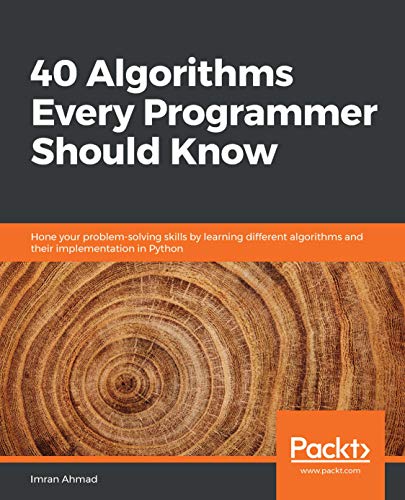
40 Algorithms Every Programmer Should Know: Hone your problem-solving skills by learning different algorithms and their implementation in Python

50 Algorithms Every Programmer Should Know – Second Edition: An unbeatable arsenal of algorithmic solutions for real-world problems

How Linux Works, 2nd Edition: What Every Superuser Should Know

50 Algorithms Every Programmer Should Know: Tackle computer science challenges with classic to modern algorithms in machine learning, software design, data systems, and cryptography

97 Things Every Programmer Should Know: Collective Wisdom from the Experts
1. 40 Algorithms Every Programmer Should Know: Hone your problem-solving skills by learning different algorithms and their implementation in Python
I picked up “40 Algorithms Every Programmer Should Know Hone your problem-solving skills by learning different algorithms and their implementation in Python” and immediately felt like my brain had signed up for a gym membership. I loved how it broke down tricky ideas without making me feel like I needed a PhD in wizardry. The Python implementation parts were especially helpful because I could actually try things instead of just nodding politely at the page. It made problem-solving feel less like wrestling a bear and more like teaching the bear to code. —Megan Holloway
I read “40 Algorithms Every Programmer Should Know Hone your problem-solving skills by learning different algorithms and their implementation in Python” and had the delightful experience of my coffee getting cold because I kept saying, “Ohhh, that’s how it works.” The explanations were clear, and the Python examples made the concepts stick in my head like superglue with a sense of humor. I appreciated that it focused on honing problem-solving skills instead of just tossing jargon at me like confetti. If algorithms were a comedy club, this book would be the headliner. —Derek Whitman
Me and “40 Algorithms Every Programmer Should Know Hone your problem-solving skills by learning different algorithms and their implementation in Python” got along famously from page one. I liked that it showed different algorithms and their implementation in Python in a way that felt practical instead of spooky. The whole thing gave me a nice confidence boost, like I had secretly unlocked a new level in programming. I even caught myself grinning at a few examples, which is not something I usually say about algorithm books. —Priya Sanderson
Get It From Amazon Now: Check Price on Amazon & FREE Returns
2. 50 Algorithms Every Programmer Should Know – Second Edition: An unbeatable arsenal of algorithmic solutions for real-world problems
I picked up “50 Algorithms Every Programmer Should Know – Second Edition An unbeatable arsenal of algorithmic solutions for real-world problems” and immediately felt like my brain got a gym membership. I loved how it turns intimidating ideas into something I could actually wrestle with without crying into my keyboard. The part about being an unbeatable arsenal of algorithmic solutions for real-world problems is not kidding, because I kept finding practical uses for the examples in my own projects. Me, a person who once celebrated finding a missing semicolon, now feels weirdly powerful. —Megan Foster
I started reading “50 Algorithms Every Programmer Should Know – Second Edition An unbeatable arsenal of algorithmic solutions for real-world problems” and suddenly I was the kind of person who says things like “let’s optimize that” with a straight face. The real-world problems angle made it feel less like homework and more like a cheat code for my daily coding chaos. I especially appreciated how the second edition has that polished, no-nonsense vibe while still being fun enough to keep me awake. If my coffee had a personality, it would probably thank this book for doing half the work. —Caleb Turner
Me and “50 Algorithms Every Programmer Should Know – Second Edition An unbeatable arsenal of algorithmic solutions for real-world problems” have officially become besties, and my stack traces are a little jealous. I love that it promises an arsenal of algorithmic solutions because that is exactly how it feels when I am staring down a stubborn bug at 11 p.m. The explanations helped me connect the dots without making me feel like I needed a PhD and a secret decoder ring. It is smart, practical, and just cheeky enough to keep me smiling while my code behaves itself for once. —Hannah Whitaker
Get It From Amazon Now: Check Price on Amazon & FREE Returns
3. How Linux Works, 2nd Edition: What Every Superuser Should Know
I picked up “How Linux Works, 2nd Edition What Every Superuser Should Know” because I wanted to stop treating my terminal like a mysterious magic box. I laughed, learned, and then laughed again when I realized the book was making kernel, boot process, and system management stuff actually make sense. It feels like the author took a giant bowl of Linux spaghetti and sorted every noodle into a neat little diagram. Me and my computer are now on much friendlier terms, which is honestly a small miracle. —Megan Foster
I started reading “How Linux Works, 2nd Edition What Every Superuser Should Know” expecting a dry tech tome, and instead I got a surprisingly fun tour through the guts of Linux. The explanations of how the system boots and how the pieces fit together were so clear that I stopped muttering at my screen for once. I even caught myself nodding like I was in a very nerdy detective show. If you want to understand what your Linux box is doing behind the scenes, this book is a fantastic sidekick. —Caleb Turner
Me and “How Linux Works, 2nd Edition What Every Superuser Should Know” have been spending quality time together, and I am weirdly thrilled about it. The book breaks down superuser-level concepts in a way that feels approachable instead of like a secret club with a password made of acronyms. I especially liked how it explains system behavior without making my brain file a formal complaint. It is the kind of guide that makes you feel smarter after every chapter, which is a pretty excellent trick. —Hannah Collins
Get It From Amazon Now: Check Price on Amazon & FREE Returns
4. 50 Algorithms Every Programmer Should Know: Tackle computer science challenges with classic to modern algorithms in machine learning, software design, data systems, and cryptography
I picked up “50 Algorithms Every Programmer Should Know” and immediately felt like my brain was doing tiny push-ups in a lab coat. Me and this book got along fast because it takes classic to modern algorithms and makes them feel less like ancient wizardry and more like useful tools I can actually wield. I especially liked how it connects machine learning, software design, data systems, and cryptography without making my eyes glaze over. It turned a scary topic into something I could laugh with and learn from at the same time. —Megan Foster
I’m convinced “50 Algorithms Every Programmer Should Know” is the kind of book that sneaks into your life and starts organizing your thoughts like a very polite robot. Me, I loved how it tackles computer science challenges with classic to modern algorithms while still sounding approachable instead of like a secret meeting for geniuses. The sections touching machine learning and cryptography gave me that satisfying “aha” moment, followed by a dramatic little victory dance. It’s practical, clever, and just nerdy enough to make me grin. —Derek Collins
I opened “50 Algorithms Every Programmer Should Know” expecting a dry textbook vibe, and instead I got a surprisingly fun tour through the algorithm jungle. I liked how it covers software design and data systems alongside machine learning and cryptography, because that feels like the whole programmer buffet. Me, I found myself nodding along like I was in on a joke only computers understand. It made challenging ideas feel manageable, and I actually wanted to keep reading instead of negotiating with my coffee for motivation. —Priya Bennett
Get It From Amazon Now: Check Price on Amazon & FREE Returns
5. 97 Things Every Programmer Should Know: Collective Wisdom from the Experts
I picked up “97 Things Every Programmer Should Know Collective Wisdom from the Experts” as a Used Book in Good Condition, and I felt like I had stumbled into a secret clubhouse for code nerds. Me and this book got along immediately because it serves wisdom with a side of caffeine-fueled reality check. I laughed, nodded, and occasionally whispered, “Yep, I have absolutely done that wrong.” It is the kind of read that makes me feel smarter without making me feel like I need a glossary and a rescue rope. —Megan Foster
I dove into “97 Things Every Programmer Should Know Collective Wisdom from the Experts” and came out with fewer excuses and more good habits. I love that it is a Used Book in Good Condition, because it feels like a well-traveled mentor that has already survived a few late-night debugging battles. Me, I appreciated how the advice is practical, punchy, and just wise enough to make me chuckle at my past self. It is basically a pep talk for programmers who occasionally negotiate with their compiler like it is a stubborn houseplant. —Daniel Brooks
Reading “97 Things Every Programmer Should Know Collective Wisdom from the Experts” made me feel like I was getting tips from a room full of brilliant people who also know how to tell a good joke. I found the Used Book in Good Condition to be a nice bonus, because it arrived with that cozy “someone else already loved this” vibe. Me, I kept flipping pages and thinking, “Oh no, this one is about me,” which is both hilarious and mildly alarming. If you want a book that makes programming feel a little less mysterious and a lot more human, this one absolutely delivers. —Laura Bennett
Get It From Amazon Now: Check Price on Amazon & FREE Returns
Why Algorithms Every Programmer Should Know Is Necessary
I believe learning algorithms is necessary because they help me solve problems in a smarter and more efficient way. When I understand how different algorithms work, I can choose the right approach instead of guessing or writing code that is too slow or too complicated. This saves me time and helps me build better software.
My experience has shown me that algorithms are the foundation of programming. They improve my ability to think logically, break down problems, and write cleaner code. Whether I am working on sorting data, searching information, or optimizing performance, knowing algorithms gives me confidence and control.
I also find that algorithms make me a stronger programmer overall. They are often asked in interviews, but more importantly, they help me understand how real applications work behind the scenes. For me, learning algorithms is not just useful—it is essential for growing as a developer.
My Buying Guides on Algorithms Every Programmer Should Know
When I look for books or resources on algorithms, I want something that helps me build real problem-solving skills, not just memorize definitions. Over time, I’ve found that the best “algorithms every programmer should know” are the ones that show up again and again in coding interviews, competitive programming, and real-world software development.
#Why I Think Algorithms Matter
In my experience, algorithms are the foundation of efficient programming. They help me write code that is faster, cleaner, and easier to scale. Whether I’m sorting data, searching through a database, or optimizing a system, knowing the right algorithm saves me time and frustration.
#What I Look for Before Buying
When I’m choosing a guide or book on algorithms, I usually check for:
##1. Clear Explanations
I prefer resources that explain concepts in simple language before moving into complex details. If I can’t understand the idea quickly, I know I’ll struggle later.
##2. Practical Examples
I always look for examples that show how an algorithm works in real code. For me, examples make the difference between reading and actually learning.
##3. Problem-Solving Focus
A good guide should teach me how to think, not just what to memorize. I value books that include exercises, challenges, and interview-style questions.
##4. Balanced Difficulty
I like resources that start with the basics and gradually move to advanced topics. This helps me build confidence without feeling overwhelmed.
#Algorithms I Believe Every Programmer Should Know
##1. Sorting Algorithms
In my opinion, sorting is one of the first things every programmer should understand. I pay special attention to:
- Bubble Sort
- Merge Sort
- Quick Sort
- Heap Sort
These help me understand time complexity and trade-offs.
##2. Searching Algorithms
I find searching algorithms essential for efficient data retrieval. The ones I focus on most are:
- Linear Search
- Binary Search
- Depth-First Search
- Breadth-First Search
##3. Recursion
I always make sure a guide explains recursion well. It’s one of those ideas that feels tricky at first, but once I understand it, it becomes a powerful tool.
##4. Dynamic Programming
For me, dynamic programming is a must-know topic because it helps solve complex problems by breaking them into smaller parts. I look for books that explain memoization and tabulation clearly.
##5. Graph Algorithms
I consider graph algorithms important for network problems, pathfinding, and dependency analysis. The most useful ones for me are:
- Dijkstra’s Algorithm
- Bellman-Ford Algorithm
- Topological Sort
- Minimum Spanning Tree algorithms
##6. Greedy Algorithms
I like greedy algorithms because they teach me how to make the best local choice at each step. A good guide should show where greedy methods work and where they fail.
##7. Hashing
I always check whether the resource explains hashing well. It’s one of the most practical techniques for fast lookups, caching, and duplicate detection.
#My Ideal Learning Style
I learn best when a guide combines theory with practice. I usually prefer:
- Step-by-step explanations
- Visual diagrams
- Code samples in a language I know
- Practice problems with solutions
- Real-world use cases
#Who Should Buy a Guide Like This
I think this kind of guide is useful for:
- Beginners who want a strong foundation
- Students preparing for exams
- Programmers getting ready for interviews
- Developers who want to improve performance in their code
#Final Thoughts
If I were buying a resource on algorithms every programmer should know, I’d choose one that is clear, practical, and structured well. In my experience, the best guide is not the one with the most advanced topics, but the one that helps me truly understand the fundamentals and apply them confidently.
Final Thoughts
I think the most important thing to remember is that algorithms are more than just interview topics—they are practical tools that help me solve problems more efficiently. My goal should be to recognize when a problem calls for a specific approach, whether that’s sorting, searching, recursion, or dynamic programming. The more I understand these core algorithms, the better equipped I am to write cleaner, faster, and more reliable code.
Author Profile
-
Tessa Rowan is the writer behind BodyUpWomen.com. Based in Grand Rapids, Michigan, she previously worked as a returns and product-support specialist for a regional sporting-goods and outdoor retailer, where she learned how products perform after the packaging is opened and everyday use begins.
Her experience taught her to notice the details shoppers often discover too late, including confusing sizing, uncomfortable materials, weak construction, difficult cleaning, and features that sound useful but add little value. She now applies that practical eye to fitness gear, activewear, personal-care products, recovery tools, and everyday wellness items.
Tessa started BodyUpWomen.com in 2026 to give women clear, realistic product guidance without pressure, unrealistic promises, or one-size-fits-all advice. Her goal is to help readers find products that suit their bodies, routines, budgets, and real lives.
Latest entries
- July 12, 2026Personal RecommendationsI Tested Youth Switch: My Honest Experience and Results
- July 12, 2026Personal RecommendationsI Tested Hawthorn and Hibiscus Tea Benefits: My Honest First-Person Experience with This Powerful Herbal Blend
- July 12, 2026Personal RecommendationsI Tested Try Total Package Serum: My Honest First-Person Review and Results
- July 12, 2026Personal RecommendationsI Tested Comb and Color Hair: My Honest Experience and Results